FIELD NOTE · ROUTE 8
Art and Real Estate: A Practical Guide for Collectors and Developers
How the residential real-estate market and the contemporary art market interact at the top of the U.S. market, and what both sides need to know to make the relationship work.
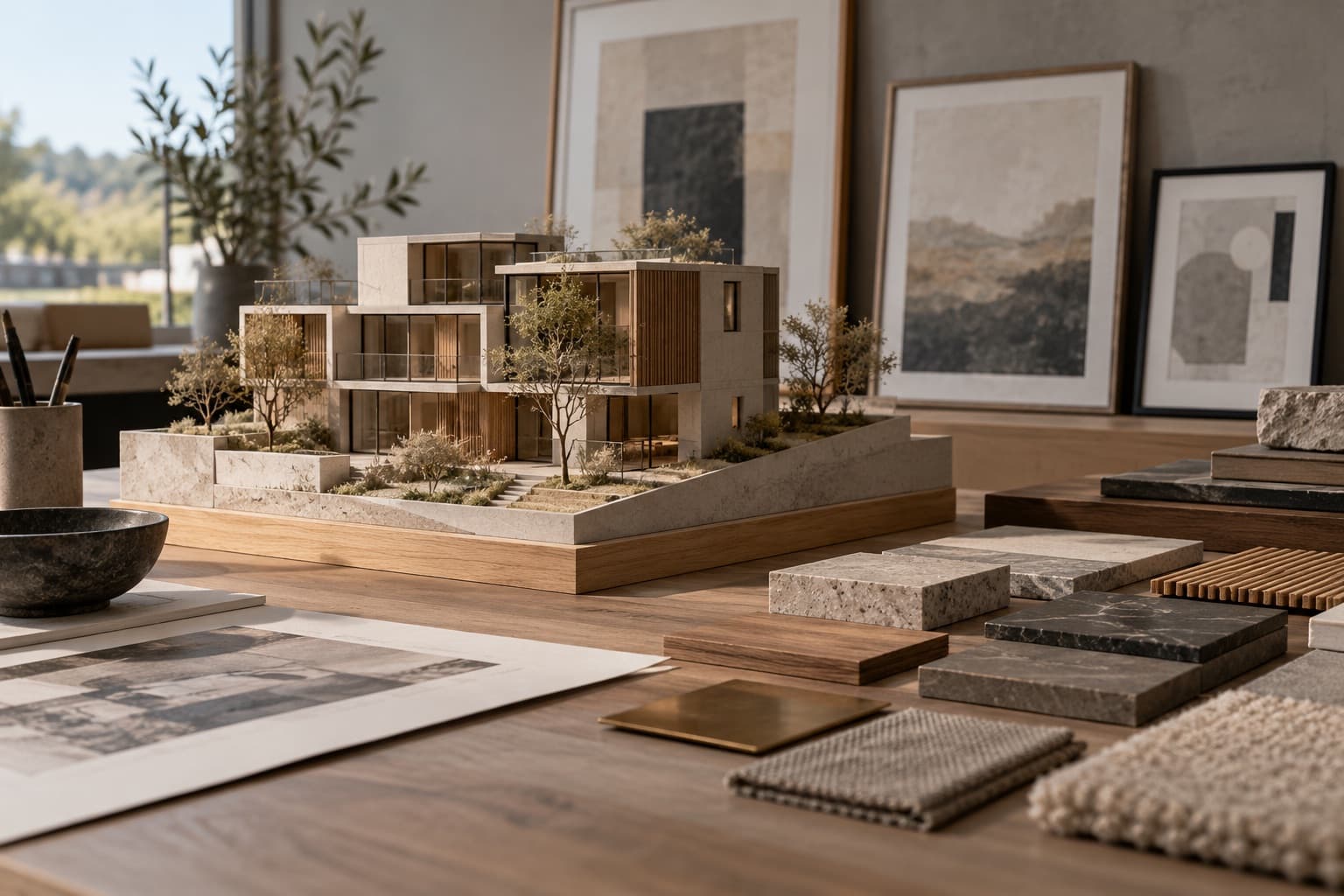
The relationship between art and real estate at the top of the U.S. market is now a defined commercial category, with dedicated advisors, programmes and budgets on both sides.
For collectors, the relationship starts at the property search and continues through acquisition, installation, documentation and ongoing stewardship.
For developers, the relationship is a marketing investment that requires its own budget, its own internal owner and its own set of metrics.
The two sides use different vocabularies, and the right advisor is the one who can translate between them.
CHECKPOINT 01 ? 118.2437? W
Why the two markets now meet
For most of the post-war period, the residential real-estate market and the contemporary art market operated as separate worlds. Real-estate agents sold properties; galleries sold art; the two communities rarely intersected. That has changed over the last fifteen years, and the change has accelerated since 2020. The 2026 Art Basel and UBS Global Art Market Report places the residential development market as the fastest-growing client segment for independent art advisors in the United States.
Three drivers explain the change. The first is the new-construction market: developers at the top of the U.S. market now treat art as part of the marketing proposition, alongside the sales centre, the model residence, the staging and the public-relations campaign. The second is the resale market: high-end listing agents have started working with art advisors to stage trophy listings with curated art, as a way to compete with new-construction product. The third is the family-office market: family offices buying primary residences now treat the art programme as part of the acquisition, not as something to be solved after the closing.
CHECKPOINT 02 ? 34.0522? N
For collectors: from property to programme
A collector who is acquiring a property and a collection at the same time has a different decision sequence than a collector who is acquiring one or the other. The decisions are interdependent: the property sets the criteria for the collection, and the collection sets the criteria for the property. A collector who acquires the property first will end up fitting the collection to the property; a collector who acquires the collection first will end up fitting the property to the collection. The order matters.
An advisor who works on both sides of this relationship will help the collector decide the order, will work with the real-estate agent to identify properties that fit the collection brief, and will work with the interior designer to ensure the construction and finishing decisions support the collection. An advisor who works on only one side will leave the collector to coordinate the rest.
CHECKPOINT 03 ? 118.2437? W
For developers: art as marketing investment
Developers at the top of the U.S. market have moved art from the soft-cost budget to the marketing budget. The shift reflects a recognition that art programmes now do real work in differentiating a property at the top of the market. The 2026 Art Basel and UBS report observes that developments with art programmes report longer days-on-market, stronger review cycles and higher per-square-foot pricing than comparable unstaged properties, though the data is still mostly anecdotal.
The most common mistake is treating the art programme as part of the staging budget. The right approach is to treat the programme as a marketing investment, with its own budget, its own internal owner and its own set of metrics. The programme should run in parallel with construction and interior design, not after them, and the curator or advisor should be brought in at the design stage rather than the staging stage.
CHECKPOINT 04 ? 34.0522? N
The advisor's role at the intersection
The advisor who works at the intersection of art and real estate needs to speak both vocabularies. The real-estate vocabulary centres on the property, the listing, the buyer, the campaign, the days-on-market and the per-square-foot pricing. The art vocabulary centres on the artist, the work, the edition, the provenance, the condition, the conservation and the stewardship. The two vocabularies overlap in places (the property as a setting for the work, the work as a feature of the property) and diverge in others (the time horizon for an acquisition, the nature of the operational follow-through).
The right advisor for an intersectional engagement is the one who can translate between the two sides without drama, who can write a programme plan that addresses both worlds, and who can manage the operational follow-through that neither side typically handles well on its own.
CHECKPOINT 05 ? 118.2437? W
Common pitfalls
Four pitfalls show up repeatedly. The first is the advisor who only works on one side: the real-estate agent who treats the art as a staging line, the gallery owner who treats the property as a venue, the interior designer who treats the art as decoration. The second is the budget that is too small to do the work: an art programme for a $50 million development that is budgeted at $20,000 will deliver a $20,000 result, and the developer will conclude that art programmes do not work. The third is the curator who is also the installer: the work suffers in both roles. The fourth is the absence of a written plan: a programme without a written plan is a programme that drifts, and a programme that drifts is a programme that fails.
A well-run programme addresses all four. The right advisor for the engagement is the one who can identify which pitfall is most likely on a given project, and who can structure the engagement to avoid it.
CHECKPOINT 06 ? 34.0522? N
What the next five years look like
The relationship between art and real estate at the top of the U.S. market is a defined commercial category, and it is still growing. The 2026 Art Basel and UBS report projects continued growth in the family-office, corporate-collection and developer engagement with the contemporary art market, with the residential development segment growing fastest.
For collectors, the implication is that an art advisor who works at the intersection is increasingly valuable, and the cost of not having one is increasingly visible. For developers, the implication is that an art programme is a marketing investment, and a credible programme requires the same discipline as any other marketing investment. For advisors, the implication is that the intersection is a defined practice, not an occasional collaboration.
Educational editorial content reflecting the author's professional perspective. Not legal, tax, appraisal or investment advice. No specific artwork, seller or transaction paid for inclusion.
Full policy ↗